Michigan Forest Life - November 20, 2025
- Dec 21, 2025
- 5 min read
Good morning from Winterfield Pines Nature Sanctuary,
The lit match carries enough light to guide it to an oil lamp. I replace the lamp's glass chimney and move to the next lamp before the match burns down.
Next the woodstove. It is 45°F inside the Treehouse - colder than I normally let it get. I let the fire burn down early last night, wondering how long the treehouse would hold its heat tonight. I was warm in bed with heavy blankets. There is a small stack of split firewood next to the woodstove this morning, set there for a fire at daybreak. It is an easy start. Three logs. A piece of a paper grocery bag. Three pieces of kindling split to chopstick-size from a cedar shingle. One match. I hear the rush of heat moving up the stovepipe and see a soft orange glow under the cast iron woodstove door. Warmth will follow.

Outside the sky lightens. This week has been a run of dramatic golden sunrises. But today the sunrise seems understated (Photo 1). Ordinary. Still beautiful. Whispers of gray clouds moving across a peach horizon. The porch thermometer says 25°F. Six degrees warmer than the last three mornings. Crisp air. Breathe deep. Welcome to the November forest.
The smell of coffee brewing drifts through the Treehouse. Yesterday evening, before following the circular staircase to ground level and pumping a fresh pitcher of water in the darkness, I poured the pitcher's last few cups into the coffee pot for this morning.
The pitcher is one and a half gallons. Most days I use one pitcher. Cooking. Dish washing. Coffee. Washing up. If I make pasta or boil potatoes, I pump another half-gallon. I pump a quart every day just for drinking. I may also add half a gallon to the humidifier that sits on the woodstove. Two gallons a day total water consumption. That's about what it adds up to.
Back in civilization, with water on demand, modern appliances, automatic dish washers, showers, and flush toilets, individual daily water usage is about 80-100 gallons per person for direct household use. A family might use 300 gallons per day. Most goes down the drain. Industrial uses of water for products we use or consume may be much more than that of our personal use.
I understand the comfort of life with modern water expectations. It is always a treat when I return home. Yes, a hot shower feels so good.
I could use more water in the forest. There is no shortage here. It is not difficult to get. But for some reason I make an effort to conserve what I pump. Perhaps it is unnecessary pumping that I try to avoid; a kind of self-discipline to bring water usage down from three gallons to two gallons per day. Ridiculous! Why do I do this? It is insignificant. I don't know why I do it. But it feels right with this forest lifestyle. Is it possible that we each use more water in a week than our grandparents used in a year?
I do imagine other places and other times where a single gallon of water made a difference. Perhaps that is what I am trying to understand. To feel. To know how a human can survive in a natural way when water is limited. It can be done...and with less water than I use in the


forest. But modern appliances - modern lifestyles would need to give way to something different.
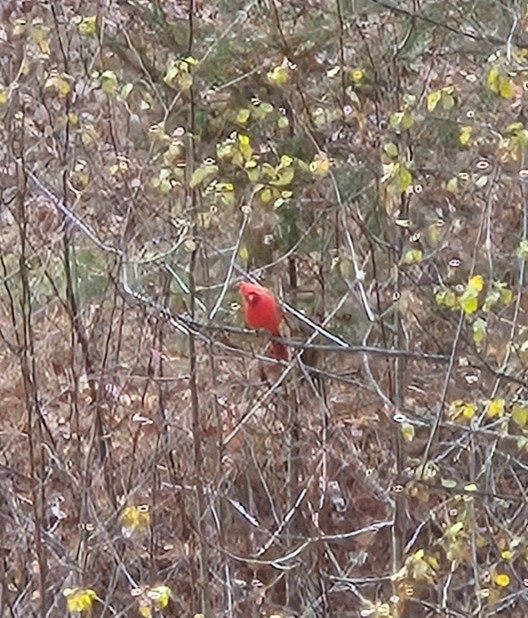
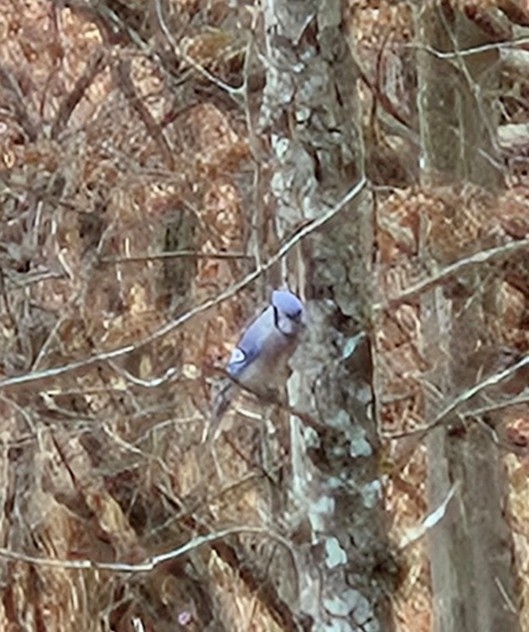
I sat in the forest yesterday watching birds. They are so hard to photograph. They are all around, but move fast. The same birds you might hope for at your feeders - cardinals, bluejays, ladderback and downy woodpeckers, juncos, chickadees, phoebes. They flutter freely about the forest. I managed to photograph a cardinal and a bluejay (Photo 2, 3).
Birds seem to fit into nature's equation. They are part of an intricately balanced natural system. They have their own lifestyle, using what they need to survive. They are part of a food chain. Eating insects, berries and seeds. Being eaten by their predators, and then contributing to the soil as they decompose.
Humans are part of the natural equation too, though we often do not behave as if it is so. Our inventions, our machines, our systems for living develop our expectations for comfort in a continuously changing way. We upgrade as we go. We develop dependencies on our own human systems rather than on the natural system in which we exist. We all lose touch with the natural world on which we depend - enticed by the technological world we are also a part of. We look at our understanding of technology as our safety net rather than our understanding of the natural world.
Does our difference from birds help us or hurt us? Do birds strive to upgrade from the ways of their past? It does not seem so to humans. But If birds could, would they change things for themselves knowing they were changing the world their offspring would need to live in?
The thing about humans is that we know our lifestyles are changing the world for our offspring - in good ways, in bad ways, and in ways that we cannot yet understand. We also know we are slowly changing the world for everything else. For the birds. For the plants. For everything up and down the food chain. What will Mother Nature do?
Today's teaser from FOREST LEGEND: THE TALE OF OL' SPLIT TOE is preview snippet 9 of 27 (Photo 4). Read and enjoy!
I wish you plenty of sunshine, and plenty of water.
Until next time,
Dan
Excerpt from Chapter 11

AD 1878 - A winter with little snow, followed by spring months with no rain, began a drought year. By late July, water that normally flowed over the beaver rise at the tag alder swamp stopped running. Water puddled inside the swamp rather than flowing into the stream that emptied into the river. The stream from the marshy wetland stopped flowing to the Clam River in August, as did most other small feeder streams down the line. By September, not enough water flowed into the Clam River to float the logs it already contained.
The loggers seemed surprised and puzzled. They stood at the edge of the river with their hats in their hands, scratching their heads, pointing, chattering.
A few weeks later, a wagon larger than any that had come before rattled down the logging road, drawn by a team of six oxen. It crossed the bridge and wiggled into the forest. Loggers continued cutting large white pines and, with the help of other devices, lifted the logs to form a neat pyramid on the wagon’s bed. The team of oxen strained, but they made it across the bridge, up the slope away from the river, and out of sight down the logging road.
These humans were so clever that Split Toe did not know what to think of it.
Copyright @ 2025 by Daniel S. Ellens
FOREST LEGEND is now available for pre-order at Amazon
Publication Date: March 31, 2026
Praise for FOREST LEGEND:
“A powerful, lyrical meditation on wilderness, myth, and memory. Ellens has created a tale that feels ancient and urgent at the same time.”
– William Gibson, author of Neuromancer and New York Times bestseller Agency.


Comments